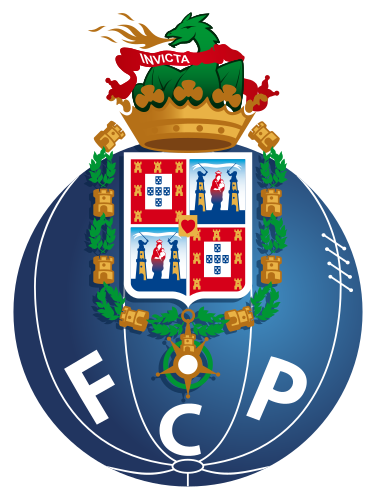
The FC Porto crest combines a blue dragon on white with the FCP initials and elements of the city arms. The dragon — nickname and symbol — evokes strength and the Invicta. Blue and white are the historic colours. The badge should not be confused with commercial mottos: it summarises more than a century of Porto tradition and European standing in Portuguese football.
Futebol Clube do Porto, founded on 28 September 1893, is one of Portuguese football's Big Three. It has won multiple league titles, Portuguese Cups and Super Cups, plus European honours — the European Cup/Champions League in 1987 and 2004, and the UEFA Cup/Europa League. Under José Maria Pedroto and later José Mourinho in the 2003/04 continental campaign, the club reinforced an image of organisation and ambition. Home is Estádio do Dragão, opened in 2003. The clássico with Benfica and the Invicta derby with Boavista define national rivalry. Blue and white and the dragon define Portista identity across more than a century.
Fans — Futebol Clube do Porto
Futebol Clube do Porto is part of the THECLUB INDEX catalogue. This page celebrates the club identity, crest and home ground.
Founded in 1893, they play at Estádio do Dragão.
Use the LIKE button in the fan area above to show your support. Every fan counts in the official tally on this page.
The FC Porto crest combines a blue dragon on white with the FCP initials and elements of the city arms. The dragon — nickname and symbol — evokes strength and the Invicta. Blue and white are the historic colours. The badge should not be confused with commercial mottos: it summarises more than a century of Porto tradition and European standing in Portuguese football.
Previous crests
Versions used in the past by Futebol Clube do Porto.
Current crest
VS
1906 - 1910
Click a crest on the timeline to compare. Double-click to enlarge.
Club history — Futebol Clube do Porto
Futebol Clube do Porto, founded on 28 September 1893, is one of Portuguese football's Big Three. It has won multiple league titles, Portuguese Cups and Super Cups, plus European honours — the European Cup/Champions League in 1987 and 2004, and the UEFA Cup/Europa League. Under José Maria Pedroto and later José Mourinho in the 2003/04 continental campaign, the club reinforced an image of organisation and ambition. Home is Estádio do Dragão, opened in 2003. The clássico with Benfica and the Invicta derby with Boavista define national rivalry. Blue and white and the dragon define Portista identity across more than a century.
Estádio do Dragão in Porto opened in 2003 and holds around 50,000. It replaced the Antas ground and hosts Primeira Liga, cups and European fixtures for FC Porto. It stands out for contemporary architecture, a blue-and-white atmosphere and its role as the hub of the Portista sporting complex.